


General Auto Speaker Installation
Do good car speakers always need an amplifier?
Eye
Whether an amplifier is really necessary depends heavily on the driver's expectations, the existing car radio, and the speakers used. Many drivers are surprised that not every speaker requires an external amplifier automatically – in some cases, a modern radio or navigation device is sufficient. For a detailed Car speakers at a glance
Efficiency and RMS power
A crucial factor is the Efficiency The speaker. Models with high efficiency (e.g., 90 dB or more) can achieve a considerable level of audio noise even with the 15–25 watts RMS of a standard radio. This means: Those who choose speakers with high efficiency often do not need an additional power amplifier. You can learn more about this in our article: Expert tip: The efficiency of car speakers – more than just maximum power
Advantages of a radio exchange
Especially in the case of older vehicles, this can be a Replacing the radio worth it. Modern devices not only offer more power, but also extensive Sound settings (e.g. DSP) and additional Cinch outputs, This makes connecting an additional amplifier easier. If you plan to expand your system in the long term, you should consider buying a new radio. Tips for optimal setup can be found here: Installing the power amplifier in the car – how to properly adjust the level control
When an end stage makes sense
An end stage is especially useful when loudspeakers with a high RMS power (from about 40 watts RMS) These models require more power to fully unleash their full sound potential – an amplifier alone usually cannot achieve this. At the same time, an amplifier also opens up the possibility of adding an additional speaker system. Subwoofer connect to significantly enhance the bass range.
Nevertheless, the following applies: Speakers with at least 90 dB efficiency They can also perform well on radios or navigation systems without the need for an external amplifier.
? Tips for practice – When an amplifier makes sense
- ? Using serial radio: For speakers up to about 25 W RMS and with good efficiency, the radio's power is sufficient.
- ? High-quality systems: Starting at about 40 W RMS or when a lot of bass is desired, installing an amplifier is worthwhile.
- ? Level and Clarity: An output stage provides more stable performance at higher volumes and prevents distortion.
- ? Don't forget the insulation: Even without an amplifier, a well-insulated door can greatly improve the sound.
Definition – Autoradio vs. power amplifier
An autoradio has a small integrated amplifier, usually built into the radio itself. 10–25 W RMS per channel. For series speakers or very efficient models, this often suffices. High-quality speakers However, with greater load capacity and higher demands on dynamics, they can only unfold their potential with a separate power amplifier. Whether an amplifier is necessary depends directly on Resilience and Efficiency turn off the speaker.
The installation situation as a deciding criterion
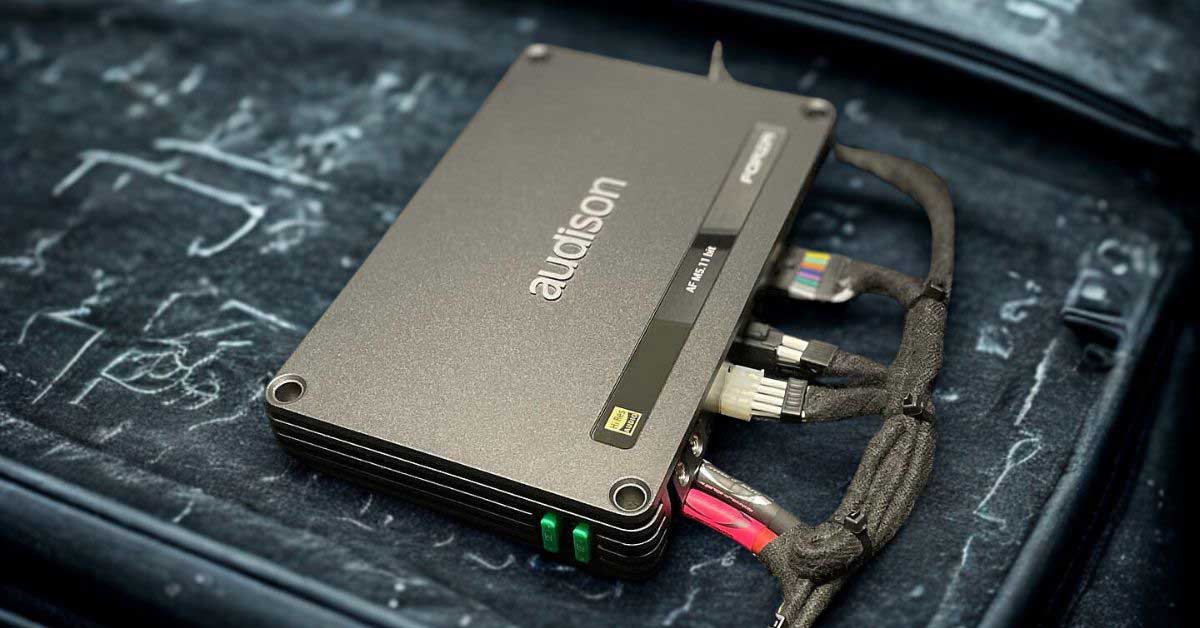
In addition to performance, the Installation situation an important role in the vehicle. Modern digital end-terminals They are now very compact – about the size of a DIN A4 sheet with only 5 cm height. This makes them easily hidden in almost any vehicle, whether under the seat, in the trunk or behind covers.
Another advantage: Through the digital technology These end-of-line devices operate very efficiently, consume little power and generate little heat. This means that they can function reliably even without complex ventilation or large cooling components. This is a real advantage especially for smaller vehicles or for users who prefer a discreet installation.
High-level inputs – practically for factory radios
Even if the radio is not to be replaced, there are solutions: Modern receivers have High-level inputs And they can be connected directly to the signal lines via so-called T-adapters. This makes it possible to significantly improve the sound quality even in vehicles with factory radios. Here’s how it works: Connecting the radio to the amplifier from the factory – this is how you improve the sound
Comparison – Car radio or amplifier?
| ⚙ Option | Sound | ? Suitable for | ? Effort |
|---|---|---|---|
| Only autoradio | Sufficient for stereo speakers, normal volume levels | Everyday users, simple upgrades | Minimal – no additional effort required |
| With power amplifier | Stronger bass, more volume, better clarity | High-quality speakers, music lovers | Medium – Wiring & installation required |
Conclusion
Whether an end stage is really necessary depends on Requirements, vehicle and budget For those who simply want clear sound at normal volume, a good radio and efficient speakers are more than enough. Those who, on the other hand, use speakers with high RMS output, seek more dynamics in the bass range and wish for additional options such as a subwoofer, will be happier in the long run with an amplifier. Thanks to modern digital technology, installation is easier than ever today and can also be easily done in compact vehicles.
Reading tips – Further articles
- Is the car radio sufficient – or is an amplifier necessary? – A more detailed comparison of when the radio is sufficient and when more power is useful.
- Installing the power amplifier in the car – how to properly adjust the level control – Step-by-step explanation of how to optimally adjust the final stage.
- How do 2-ohm speakers provide more power at the power amplifier? – Why impedance is crucial and how to extract more power.

 German
 English